
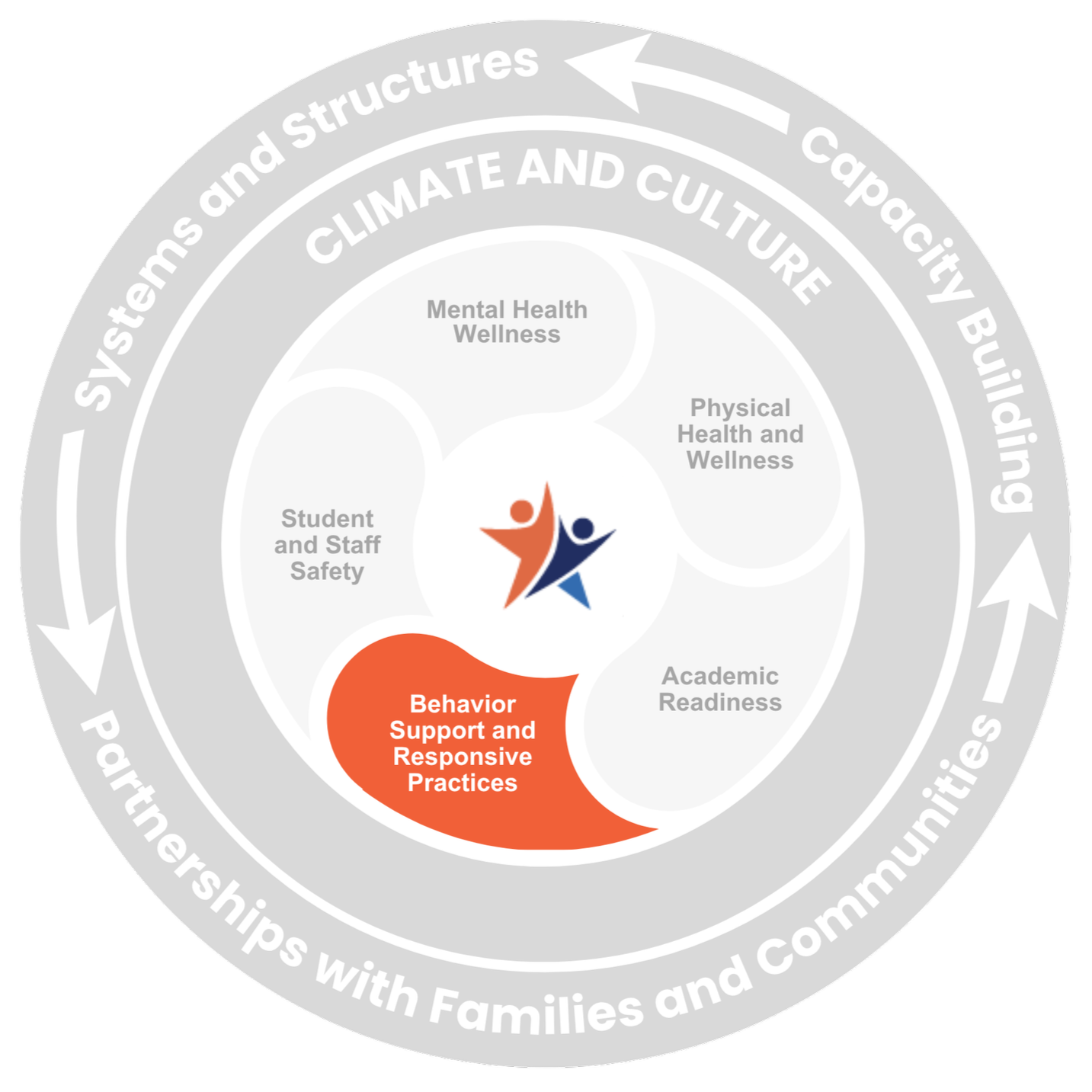
SSF Lever 4:
Behavior Support and Responsive Practices
Behavior Support and Responsive Practices is a continuum of proactive and responsive discipline strategies that reinforce the school’s focus on growth, learning, and long-term changes in behavior. In addition to the requirements in Chapter 37, this consists of both positive reinforcement and responsive consequences with a corrective teaching component when necessary. Responsive practices assist schools in creating an environment where all stakeholders are safe, and students are held accountable and accept responsibility for their actions.
-
Establish a common language and expectations to create a positive and productive atmosphere
Key Practice 4.1.1: Behavioral Data
Use behavior data to plan proactive supports.
Key Practice 4.1.2: Clear Behavioral Expectations
Establish three to five common expectations across district and campus.
Key Practice 4.1.3: Use of Varied Reinforcers
Reinforce desired behavior with immediate praise and an array of varied, meaningful reinforcers.
-
Teach structured, expected behavior and skills, including clear guidelines, to create a cohesive learning environment
Key Practice 4.2.1: Academic Teaching Model
Instruct expectations using an academic teaching model.
Key Practice 4.2.2: Teach Replacement Behavior
Focus on replacement behavior over inappropriate behavior.
Key Practice 4.2.3: Structured Expectations
Implement a predictable and structured environment.
-
Address and manage behavior constructively through a continuum of response
Key Practice 4.3.1: Range of Behavioral Classroom Interventions
Employ a range of interventions for problem behavior that are documented and delivered consistently.
Key Practice 4.3.2: Behavior Management Protocols
Determine a campus-wide continuum: office-managed, behavior support team–assisted, or classroom-managed behavior.
Key Practice 4.3.3: Learning-oriented Consequences
Incorporate common redirections or consequences with a focus on learning, reteaching, and practicing expected behavior.
Key Practice 4.3.4: Range of Behavioral Office Interventions
Aim to address the root causes of behavior and/or skills deficit.
-
Train staff in fair, consistent, equitable discipline practices, incorporating skills-deficit and root-cause training
Key Practice 4.4.1: Training on Behavior Support and Responsive Practices
Train staff in positive behavior support, responsive practices, root cause analysis, and classroom management techniques.
Key Practice 4.4.2: Restorative Practices
Utilize and train restorative approaches to repair relationships and increase accountability to the community.
Key Practice 4.4.3: Consistent Strategies Process
Implement and teach consistent prevention, intervention, and postvention strategies across settings.
Key Practice 4.4.4: Best Practices in Conflict Resolution
Equip staff with conflict resolution techniques to address heightened situations among families, students, and staff members.
-
Provide interventions focusing on engagement, attendance, and root causes of attendance issues
Key Practice 4.5.1: Attendance Data Monitoring System
Monitor data to assist in identifying and addressing trends and patterns.
Key Practice 4.5.2: Chronic Absenteeism and Truancy Prevention
Provide interventions focusing on engagement, attendance, and root causes of attendance issues.
Key Practice 4.5.3: Provide Engaging Instruction
Increase relationships and engaging instruction to impact attendance positivity.
-
Create an environment that encourages positive behavior and learning through increased support from the BST (TBSI) team
Key Practice 4.6.1: Availability of Behavior Support Team
Create availability for responsive support to provide students with effective instruction, including clear communication of expectations, shaping of behaviors, and reinforcement of responses.
Key Practice 4.6.2: Continuum of Proactive Support
Identify and implement a continuum of proactive support.
-
Identify, teach, and transfer positive school behaviors to prepare students to engage in learning and in lifelong success
Key Practice 4.7.1: Teach Positive Social Behaviors
Identify, teach, and transfer positive social behaviors across all settings.
Key Practice 4.7.2: Align Positive Behaviors with Expectations
Connect positive behaviors with common school-wide expectations.