Student Support Framework

About
Student Support Framework

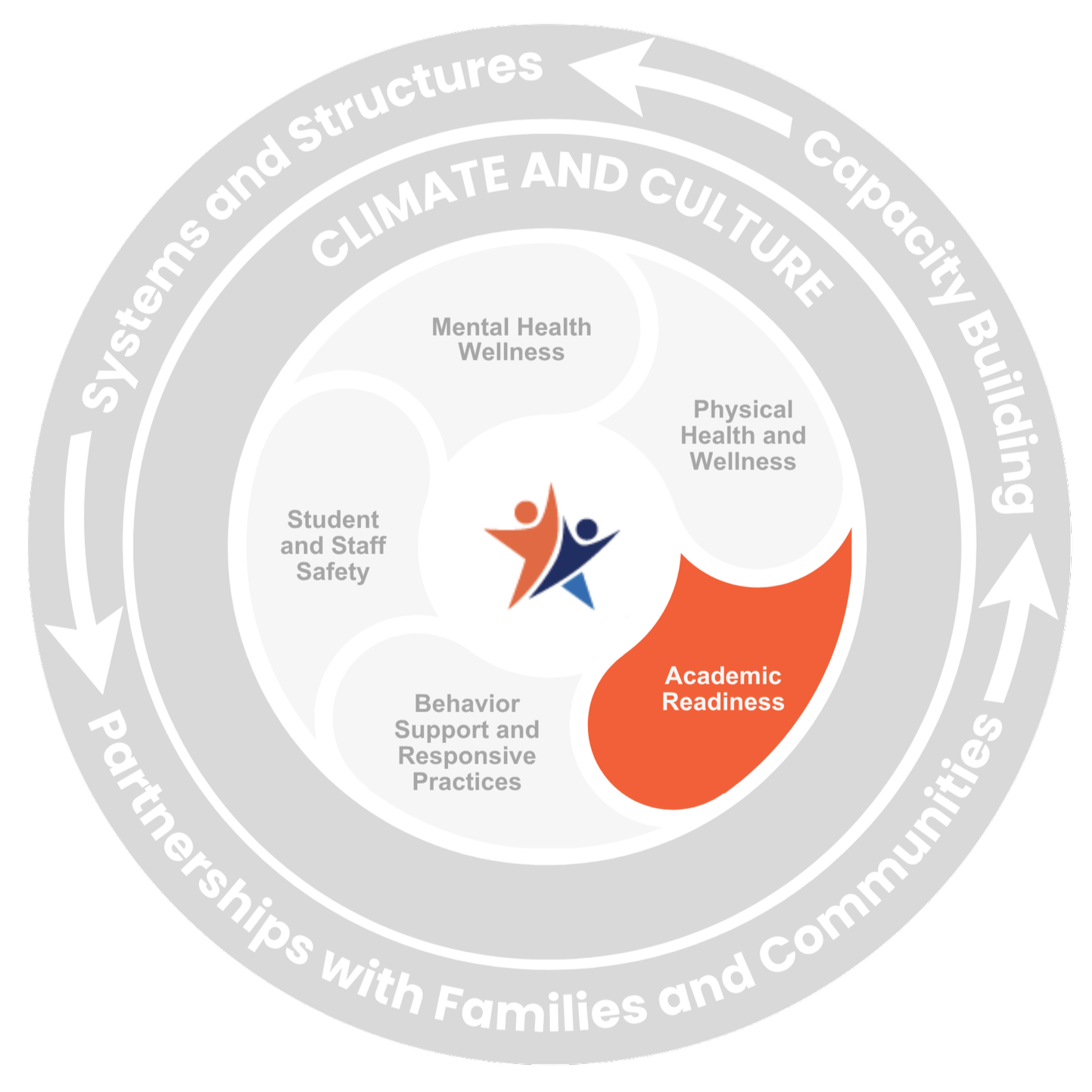
The Student Support Framework is designed to comprehensively address the multifaceted needs of students, encompassing mental and behavioral health and wellbeing, physical health and wellness, student and staff safety, and supportive discipline. The structured framework promotes establishing and implementing secure and supportive learning environments and practices, supporting LEAs in evaluating and strengthening systems to meet non-academic needs effectively.  By prioritizing the comprehensive development of students, the framework equips students to succeed academically and to thrive in all aspects of life.  

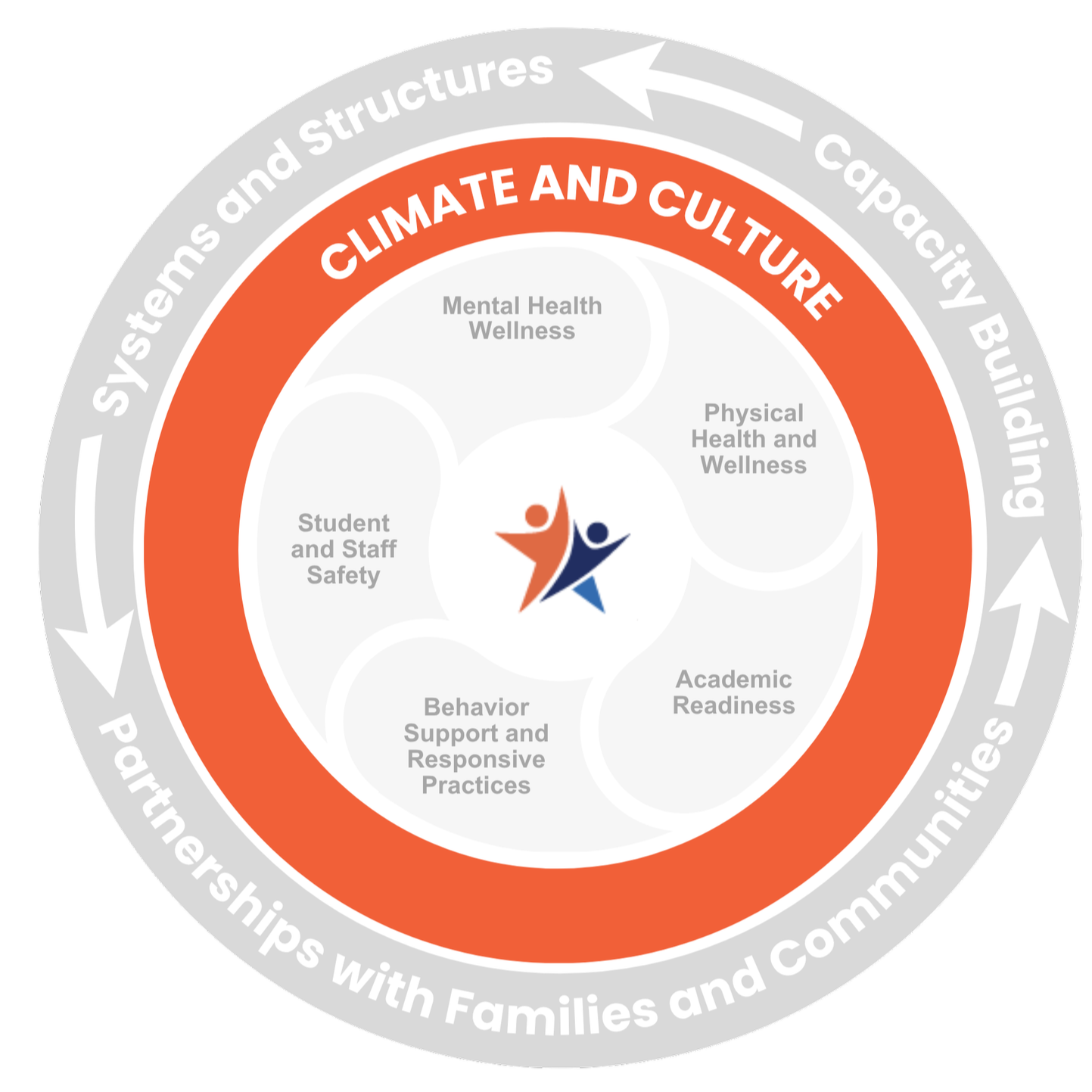
The SSF prioritizes students’ well-being and growth. At its core lie the five foundational components. These are the components that must be in place and be effective for a student to be healthy and well and to thrive. Surrounding the foundational elements are Climate and Culture. The foundational components can only be effective with a strong campus and district climate and culture. This includes positive relationships, a belief in the unique potential of every student, and the establishment of campus-wide expectations that provide continuity for students and classrooms.

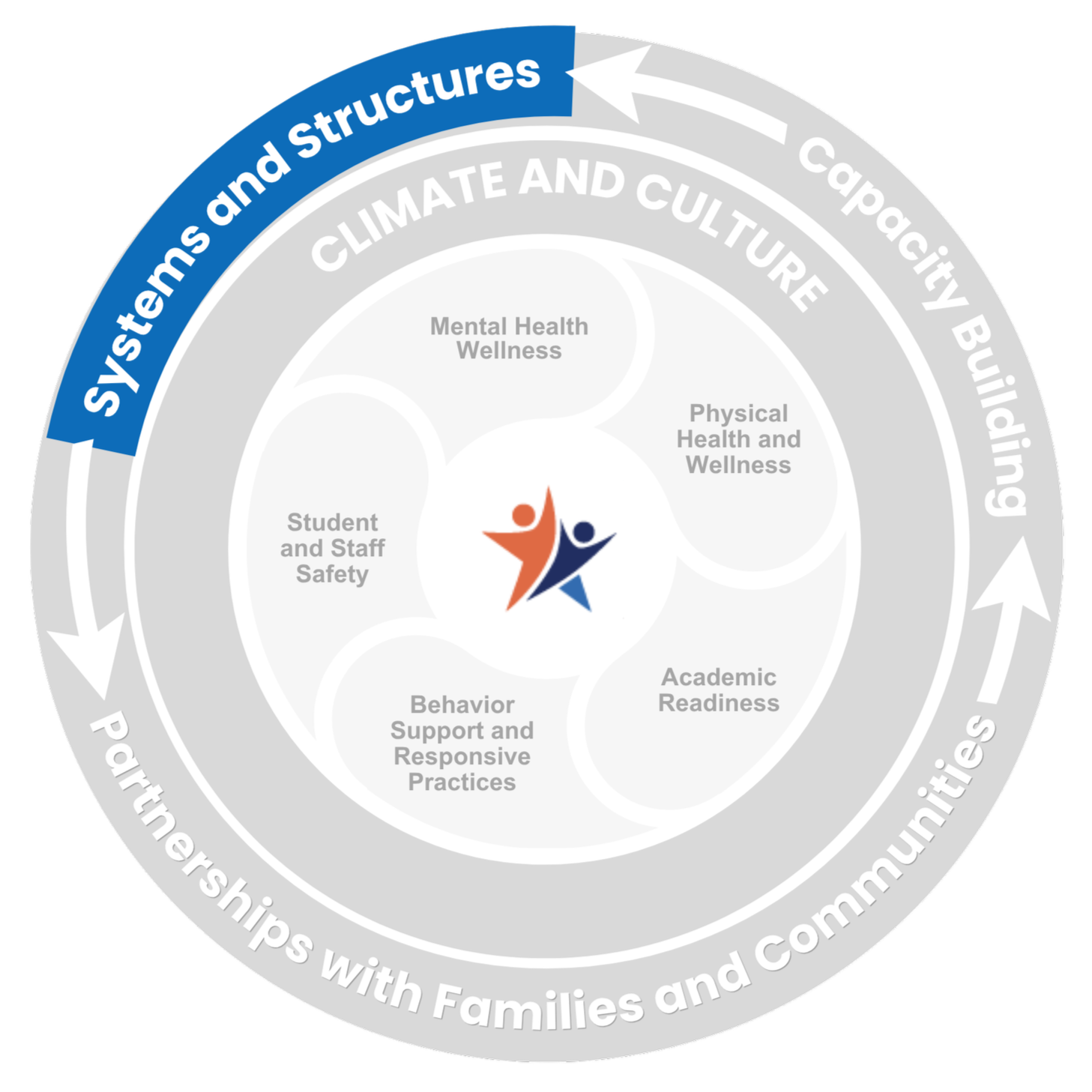
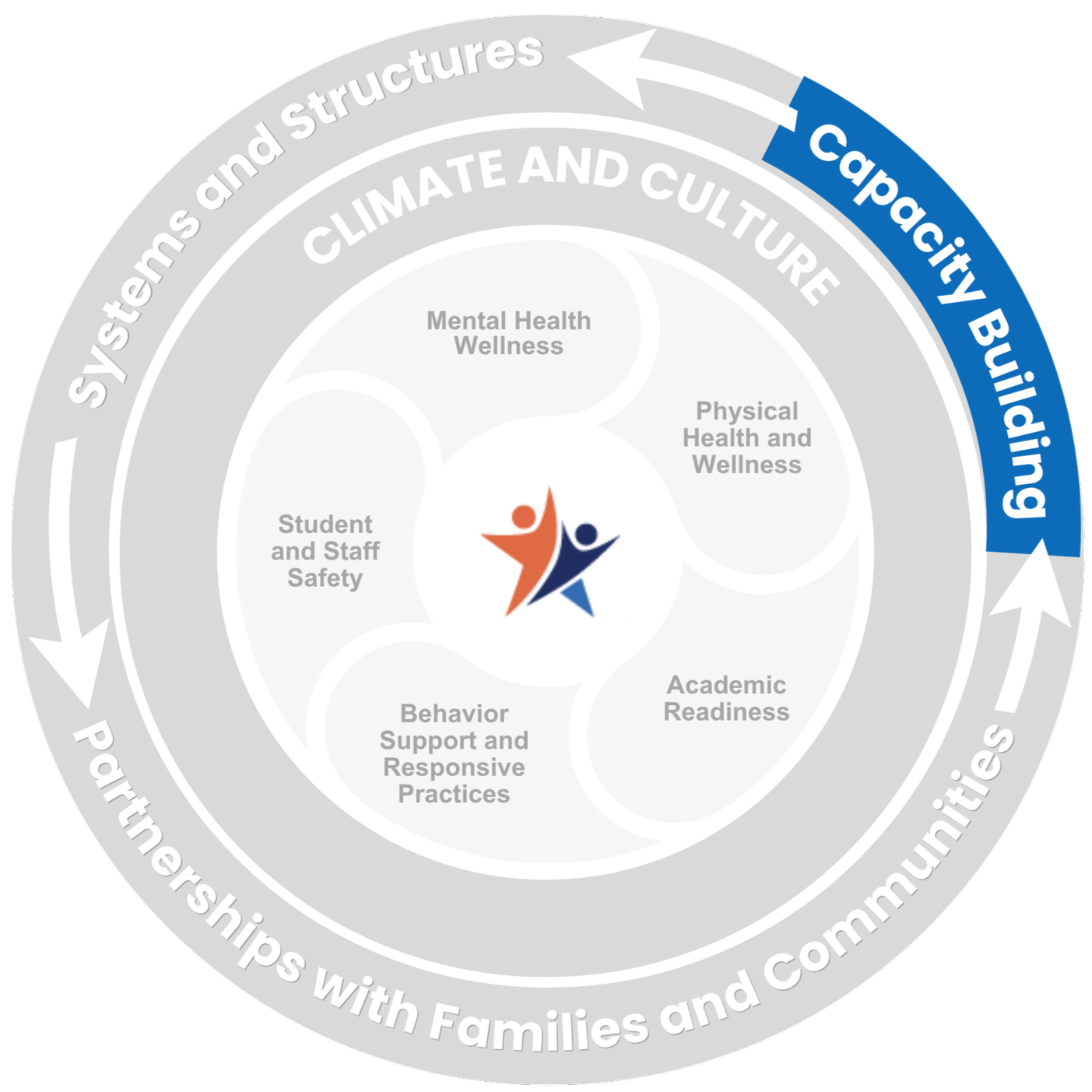
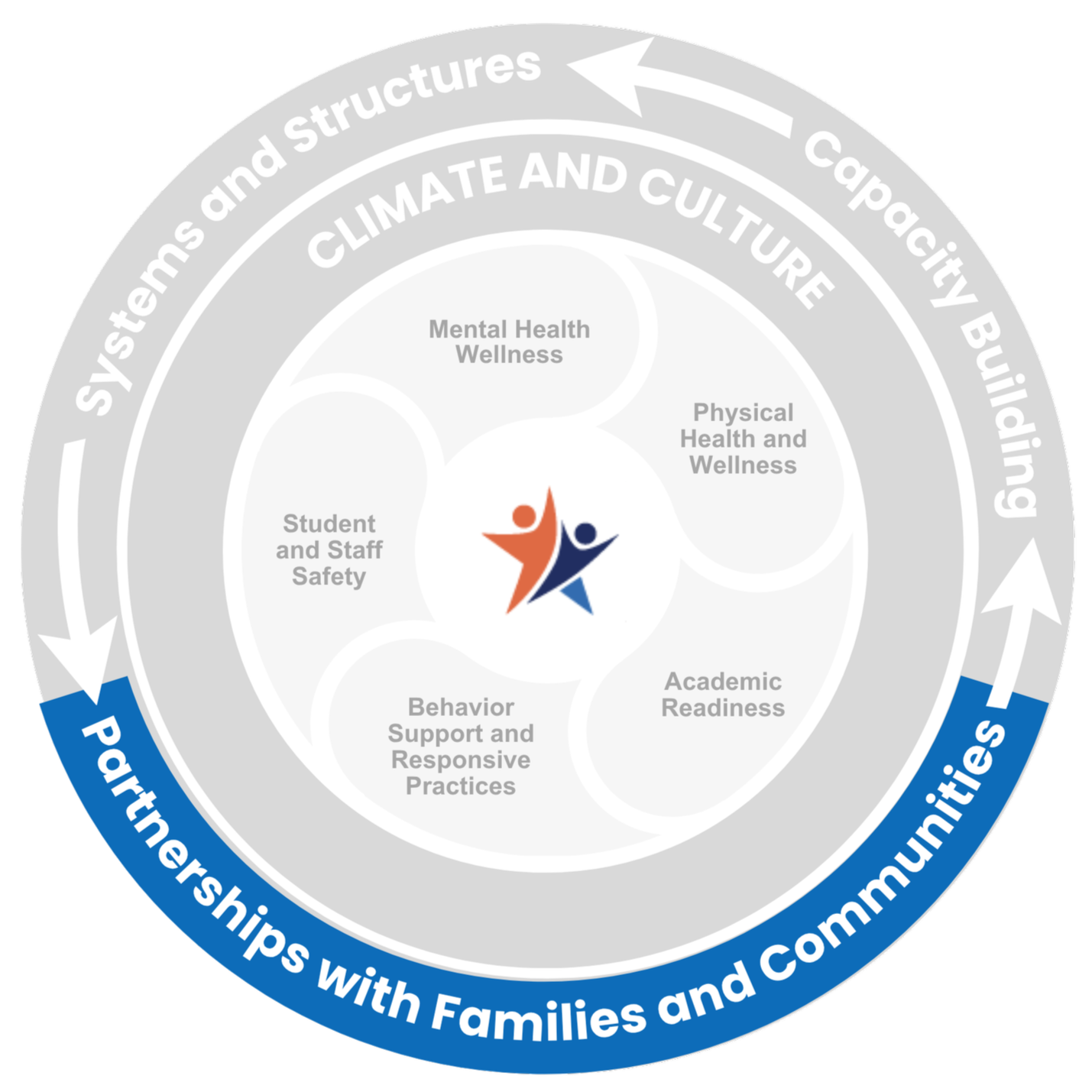
The three foundational supports are interwoven throughout the climate and culture and the foundational components. These include:

  • Systems and Structures

  • Building Capacity

  • Partnerships with Families and Communities
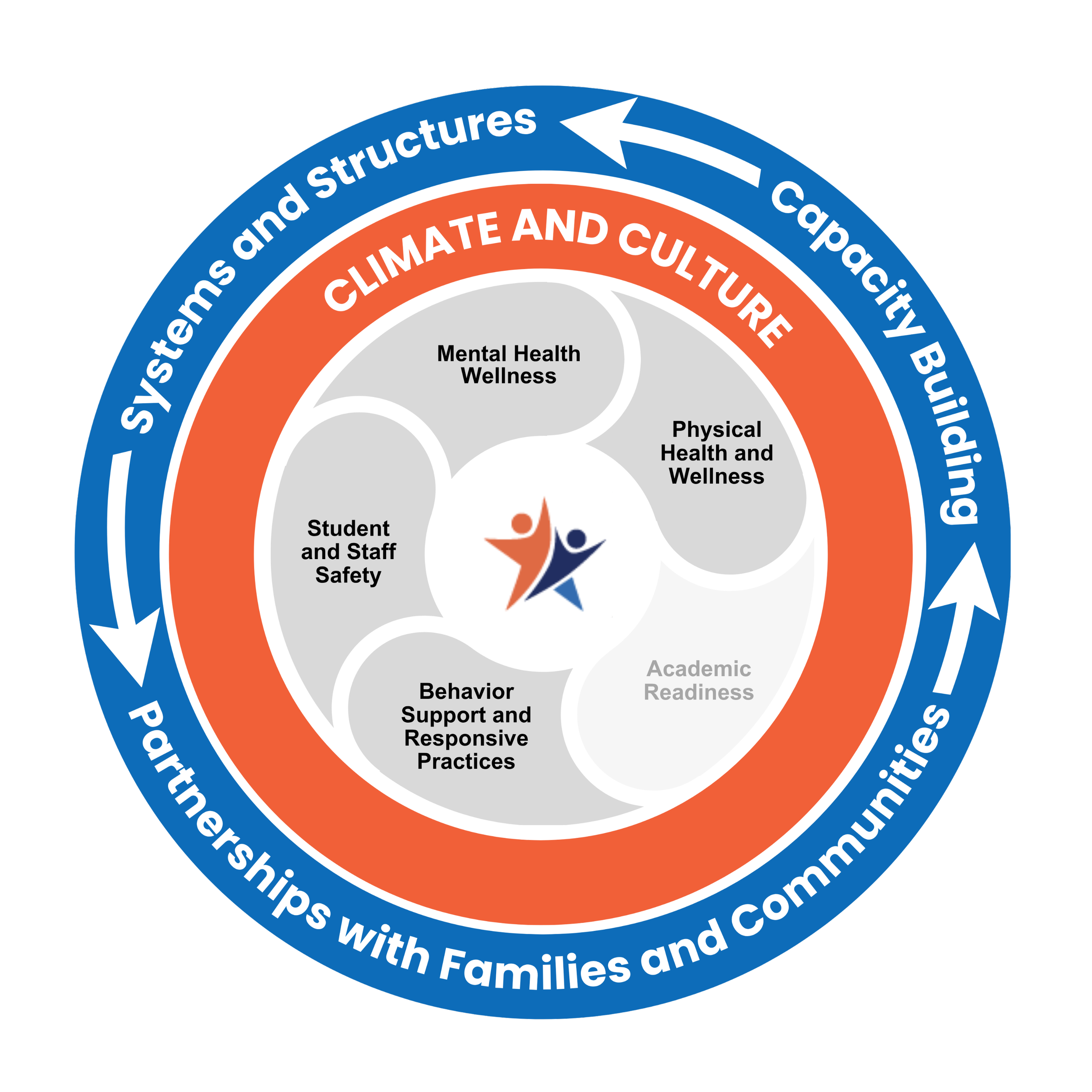
A circular diagram illustrating the interconnectedness of systems and structures supporting health and well-being, with concentric rings labeled 'Systems and Structures', 'Capacity Building', and 'Partnerships with Families and Communities', surrounding inner segments on mental health, physical wellness, student safety, supportive discipline, and academic readiness.

The Structure of the
Student Support Framework
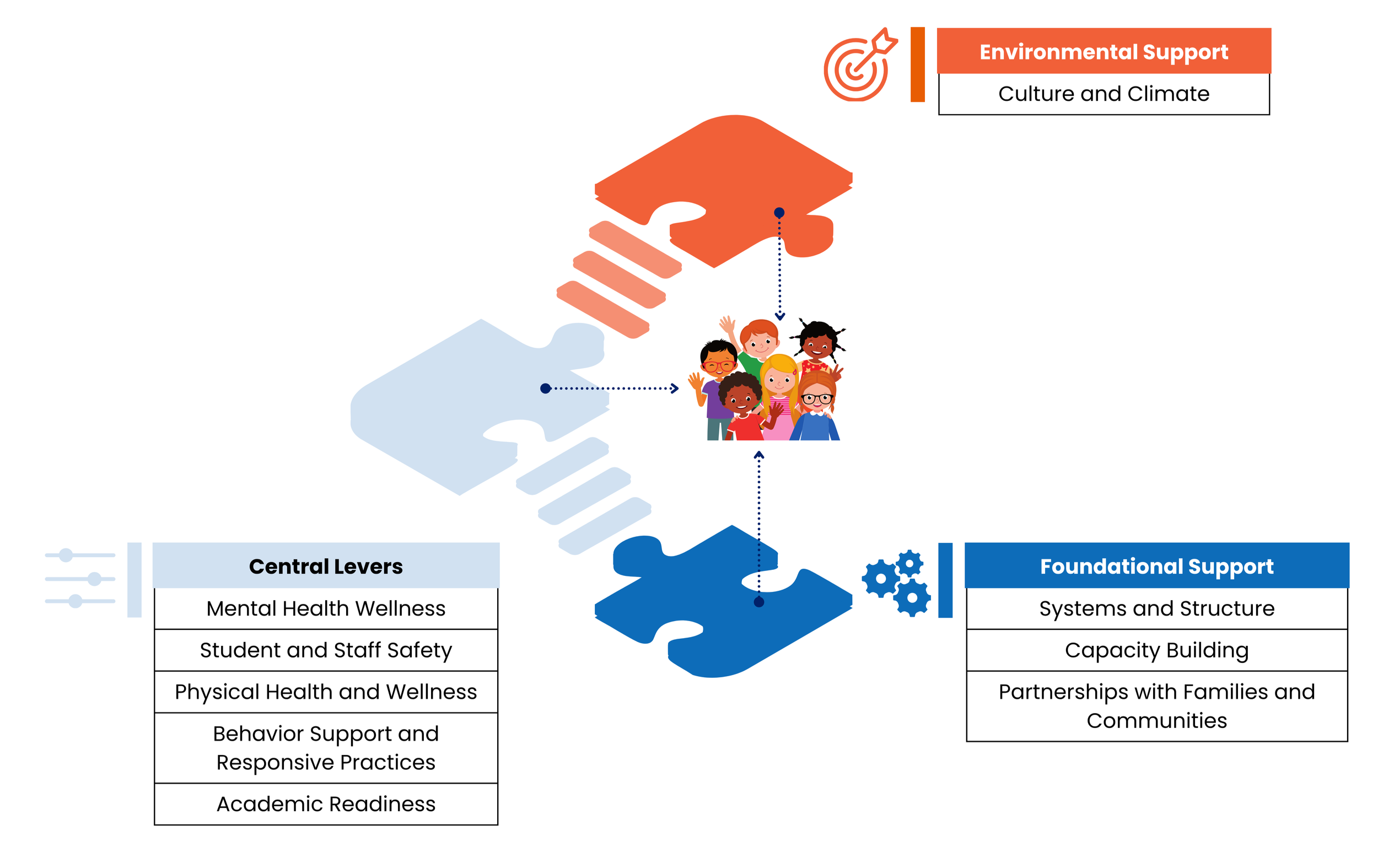
Diagram showing a central puzzle piece connecting two supporting puzzle pieces labeled 'Foundational Support' in blue and 'Environmental Support' in orange. The Foundational Support box contains systems and structure, capacity building, and partnerships with families and communities. The Environmental Support box includes culture and climate. At the center, there is a diverse group of children smiling and waving.
  • The lever is the largest category that high-performing campuses focus on. The SSF is made up of nine levers. The components of each lever are the actionable elements to improve student outcomes.

  • Within each lever, you will find Essential Actions. The Essential Actions describe what the most effective schools do to support non-academic needs of students.

  • Each Essential Action includes a set of Key Practices that define what the essential action entails when implemented with fidelity. Campus leaders can utilize Key Practices to define action steps taken to achieve Essential Action Practices.

  • The Success Criteria further defines the Key Practice as “look fors” or evidence. If the Key Practice is being implemented with fidelity, the success criteria can be collected or observed as evidence of success.

  • Under each lever, you will find the District Commitments. The District Commitments describe what district leaders do to ensure that schools are set up for success. They serve as foundational structures and systems upon which school-based best practices can be built.

  • The SSF includes a diagnostic assessment that allows campus teams to evaluates the health of student support systems using a four-point scale. Teams should work toward consensus by applying objective judgment, guided by evidence and data, when determining ratings.

Levers

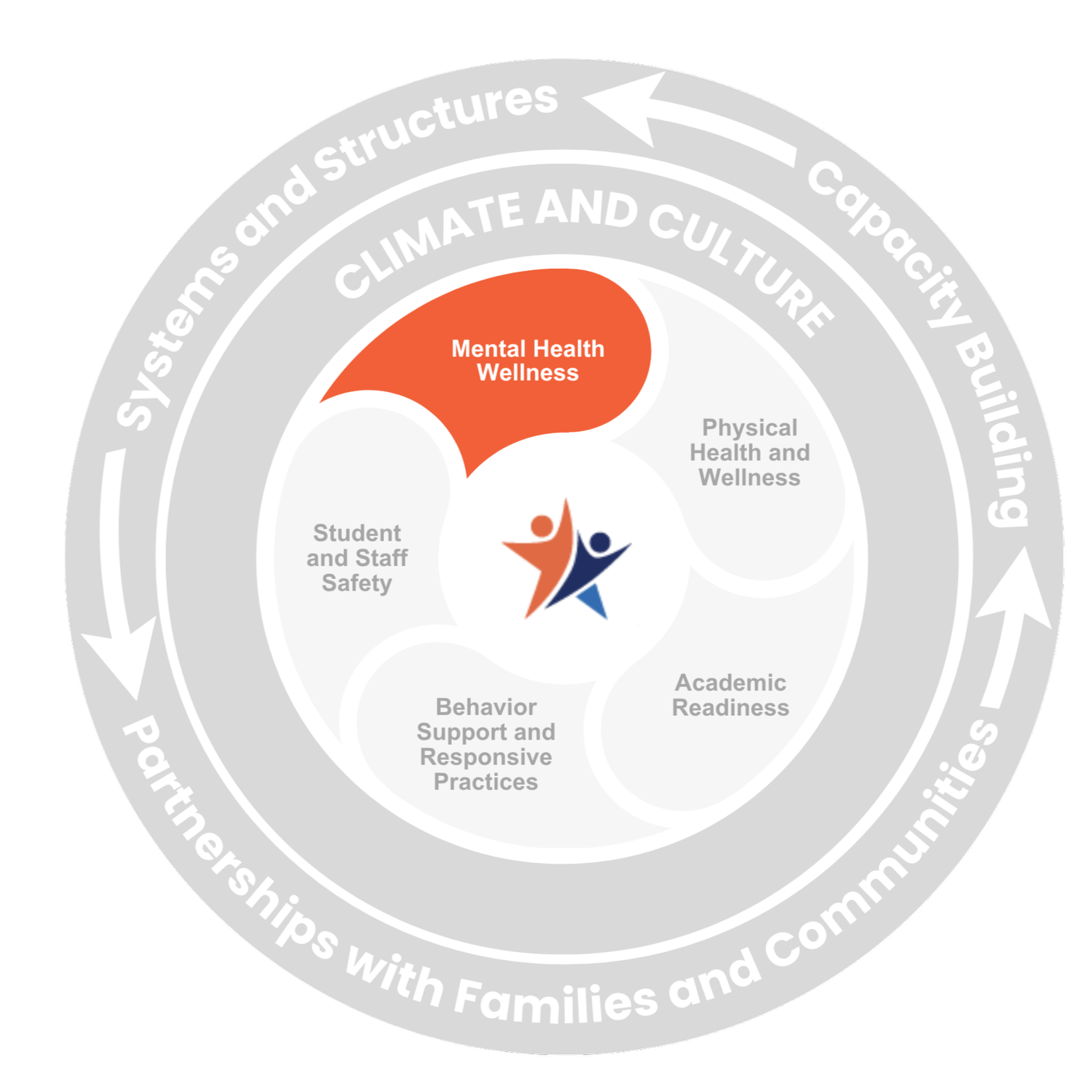
  • A circular infographic showing components of well-being, including mental and behavioral health, physical health, academic readiness, supportive discipline, student and staff safety, and climate and culture, with surrounding text emphasizing systems and community partnerships.

    SSF Lever 1: Mental and Behavioral Health and Well-being

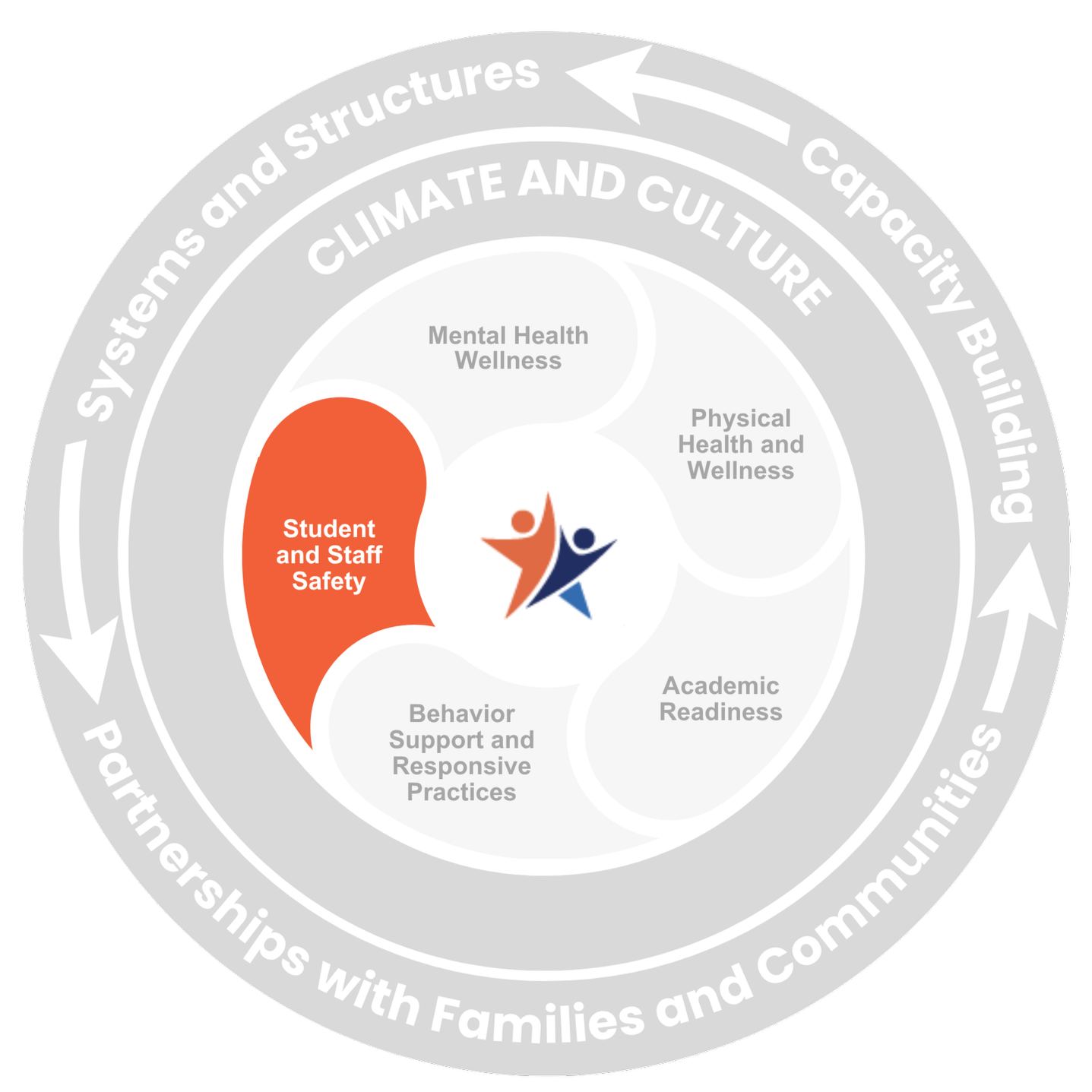
  • A circular infographic showing the relationship between climate, structures, and student safety, with inner sections labeled mental health, physical health, academic readiness, and supportive discipline, emphasizing student and staff safety.

    SSF Lever 2: Student and Staff Safety

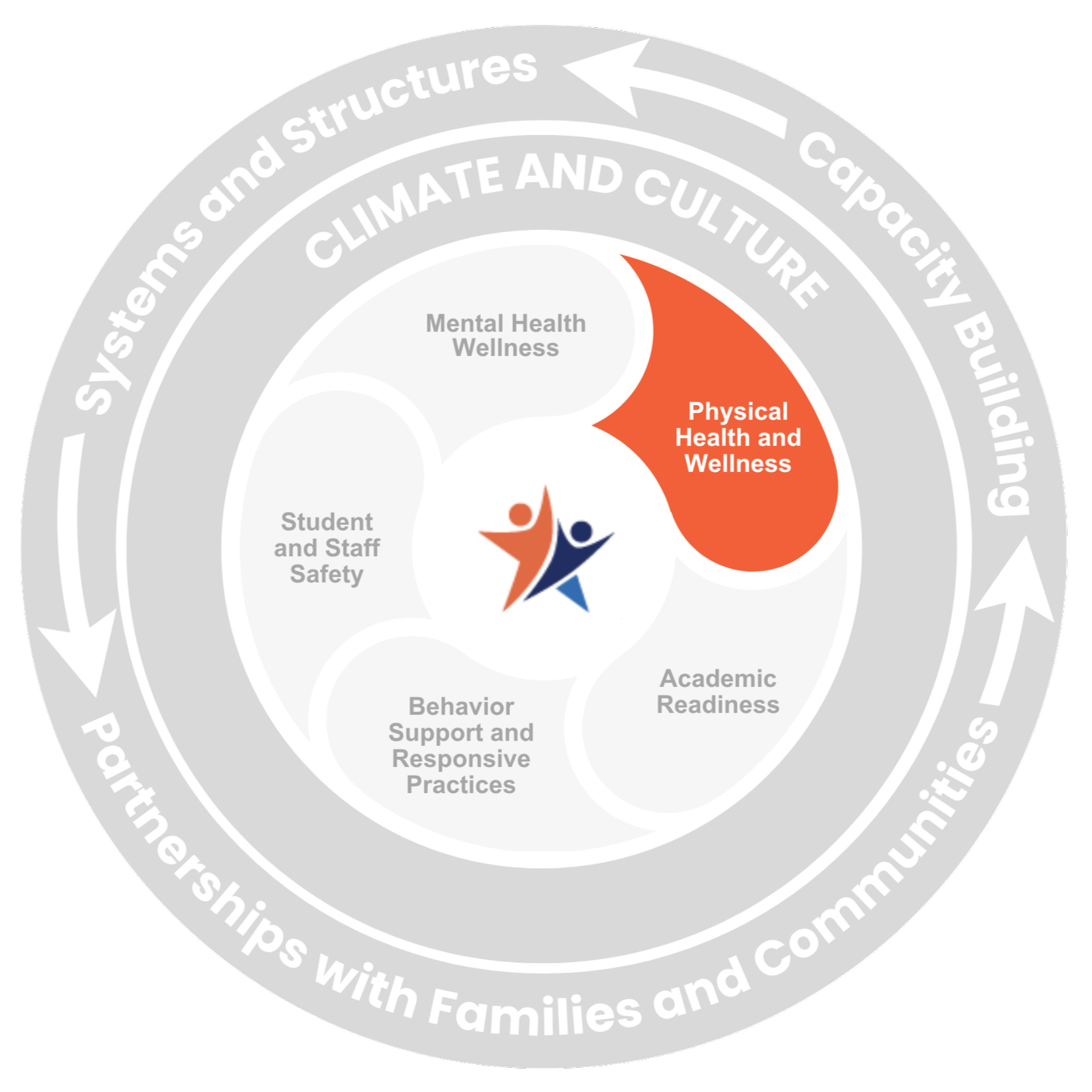
  • A circular diagram illustrating the interconnection of systems and structures impacting students, with segments on physical health, mental health, academic readiness, safety, and discipline, surrounded by a framework of systems and structures, and keywords like climate and culture, capacity building, partnerships, with arrows indicating ongoing processes.

    SSF Lever 3: Physical Health and Wellness

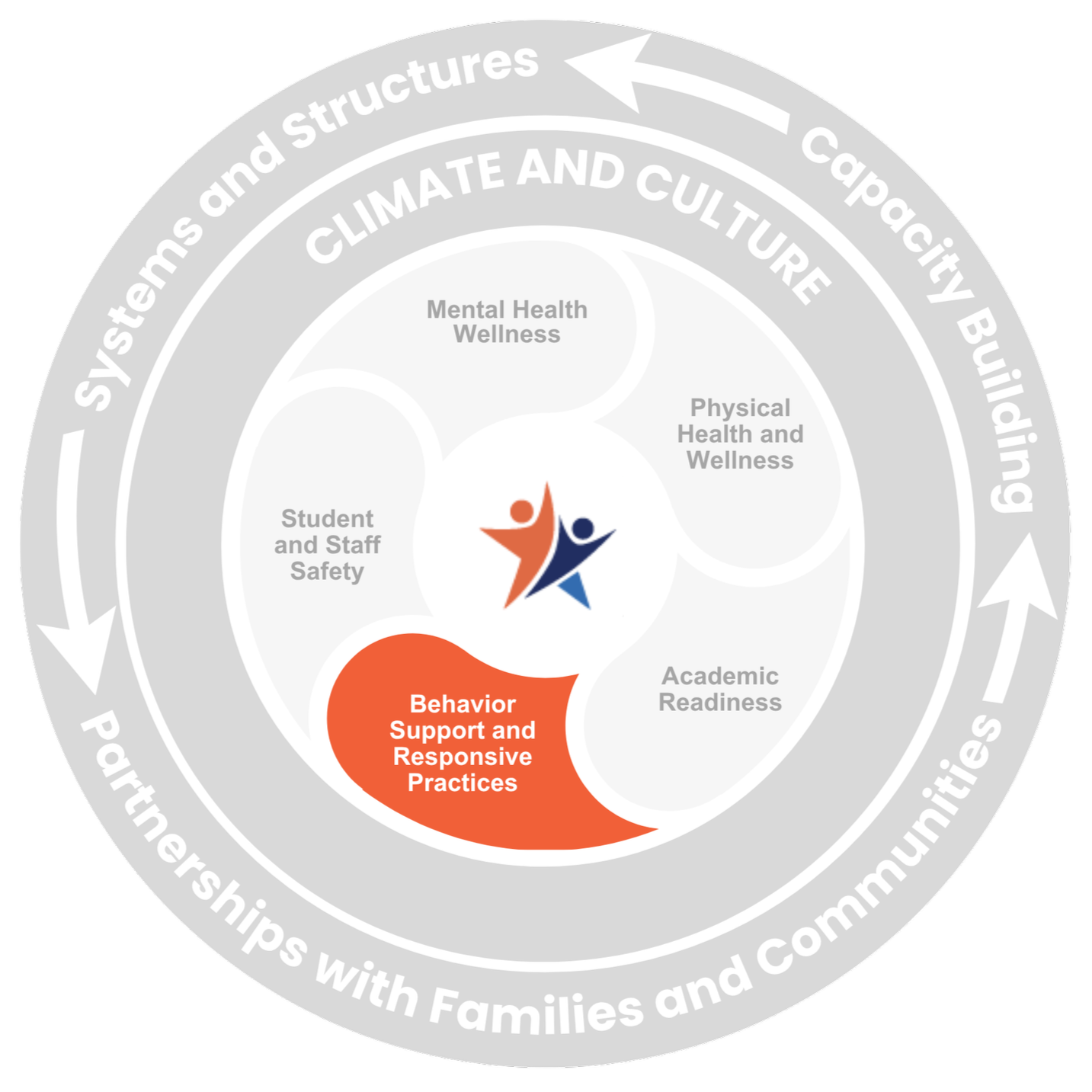
  • Diagram illustrating community health and well-being with sections for mental health, physical health, academic readiness, student safety, and supportive discipline, encircled by arrows indicating systems and structures, and a broader inclusion of campus building partnerships with families and communities.

    SSF Lever 4: Supportive Discipline

  • Diagram illustrating a framework with four inner categories: Mental and Behavioral Health and Well-being, Physical Health and Wellness, Student and Staff Safety, Supportive Discipline, and Academic Readiness. The framework emphasizes systems and structures in climate and culture, encapsulated within outer rings labeled 'Capacity Building' and 'Partnerships with Families and Communities'.

    SSF Lever 5: Academic Readiness

  • Diagram of a community health and wellness framework with a blue outer ring reading 'Capacity Building, Systems and Structures, Partnerships with Families and Communities.' Inside, a gray circle lists areas: student and staff safety, mental and behavioral health, physical health, academic readiness, and supportive discipline.

    SSF Lever 6: Systems and Structures

  • Diagram showing a central icon of two stylized figures in orange and blue holding hands, surrounded by overlapping circles labeled with health and wellbeing topics, all encircled by a blue ring with arrows and text promoting system and structure capacity building.

    SSF Lever 7: Capacity Building

  • Diagram illustrating the interconnected components of health and community building, including climate and culture, systems and structures, and capacity building, with subcategories like mental health, physical wellness, academic readiness, safety, and discipline.

    SSF Lever 8: Partnerships with Families and Communities

  • Diagram illustrating a community health model with concentric circles. The innermost circle contains sections labeled Mental and Behavioral Health and Well-being, Physical Health and Wellness, Academic Readiness, Student and Staff Safety, and Supportive Discipline. The next ring is labeled Climate and Culture, and the outer ring emphasizes the importance of Systems and Structures, Capacity Building, Partnerships with Families and Communities.

    SSF Lever 9: Climate and Culture

Student Support Framework Tool Kit

  • A man is showing a model airplane to a group of children in a classroom with large windows. The classroom has educational posters and supplies. The image includes a logo and text for the Texas Center for Student Supports (TCSS) and the Texas Education Agency.

    Student Support Framework Tool Kit

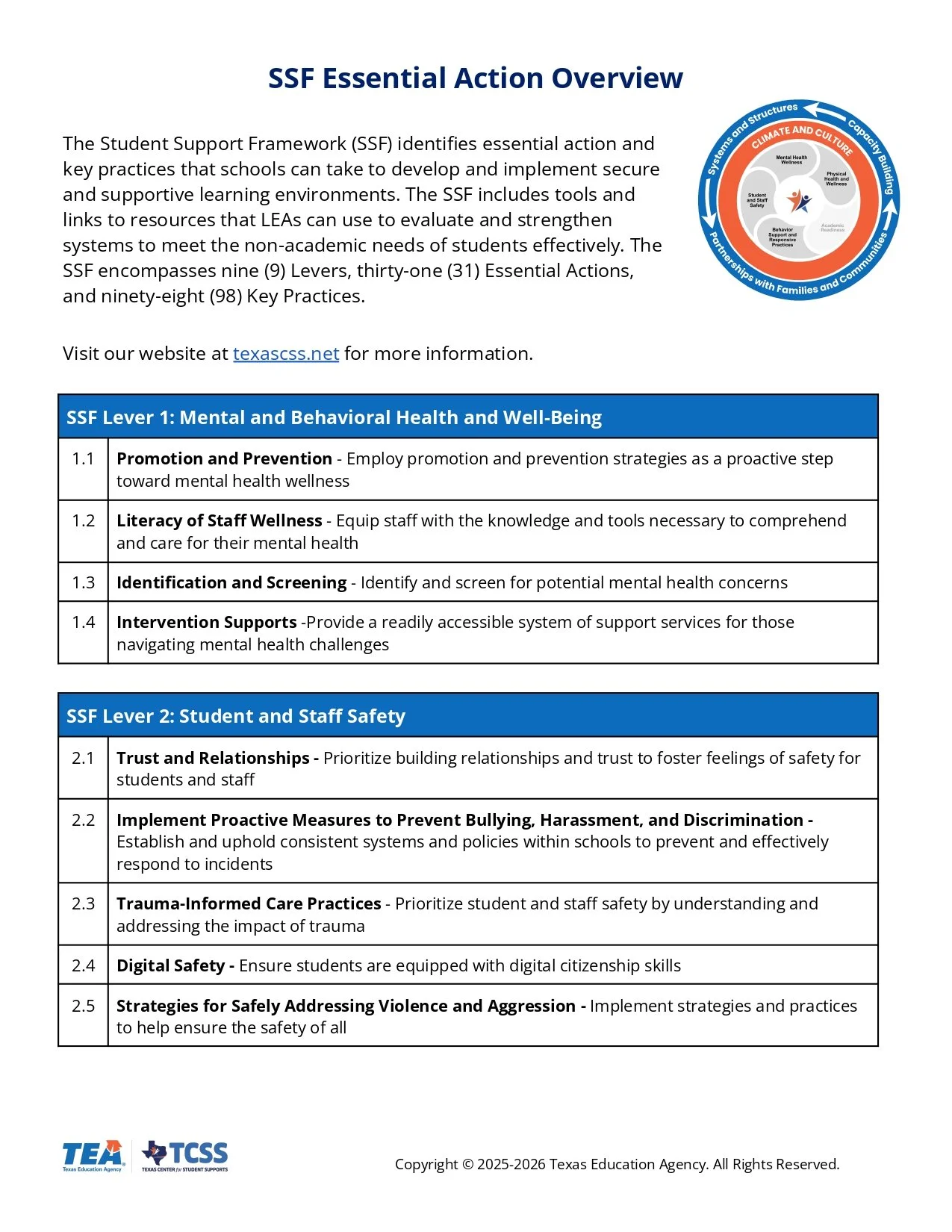
  • Overview of the SSF Essential Action Framework highlighting key practices for mental, behavioral, safety, and violence prevention in schools.

    Student Support Framework Essential Action Overview

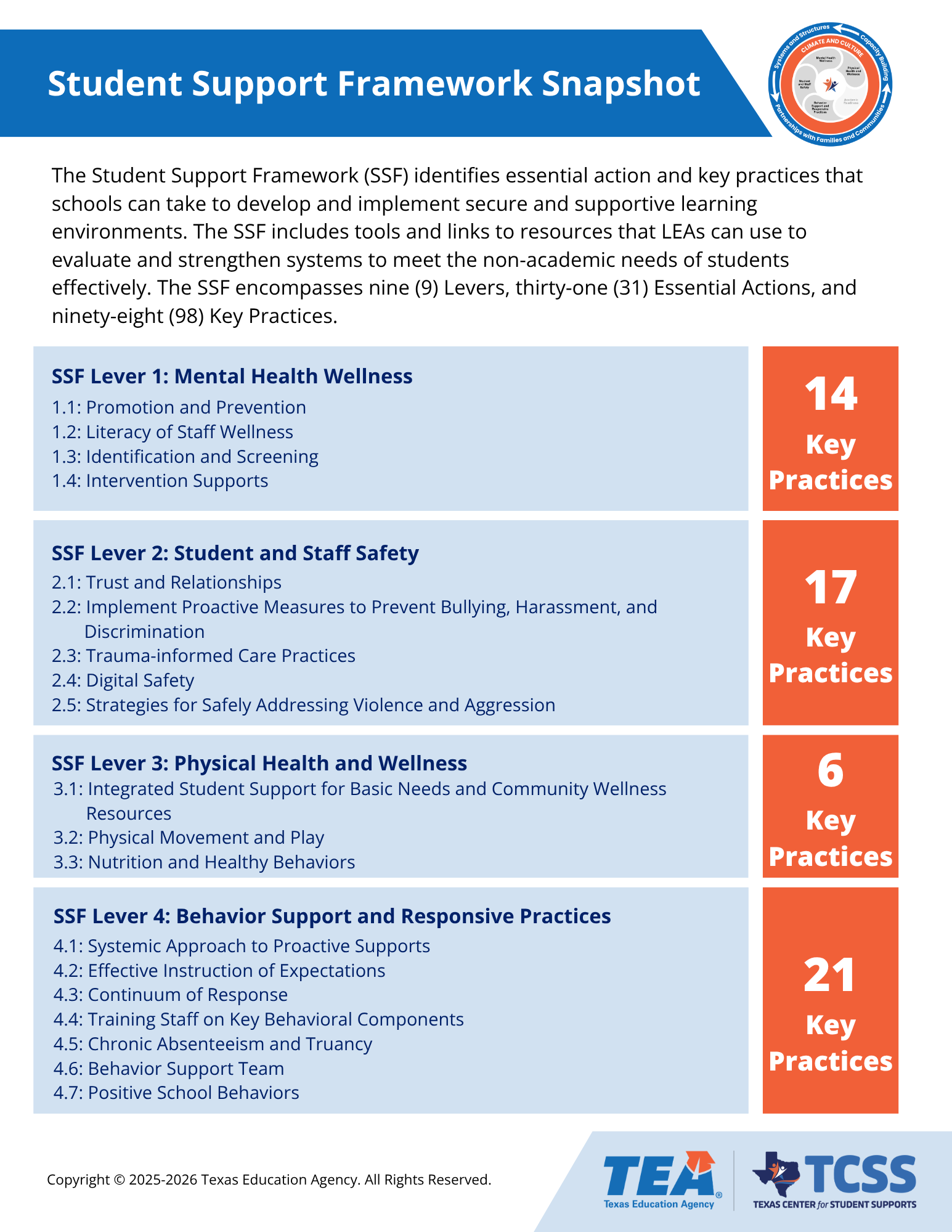
  • A detailed chart titled 'Student Support Framework Snapshot' outlining nine action areas and 110 key practices for developing supportive learning environments. The framework is organized into four levels: Mental and Behavioral Health, Student and Staff Safety, Physical Health and Wellness, and Supportive Discipline, each with specific practices and numbered key practices.

    Student Support Framework Snapshot 2025